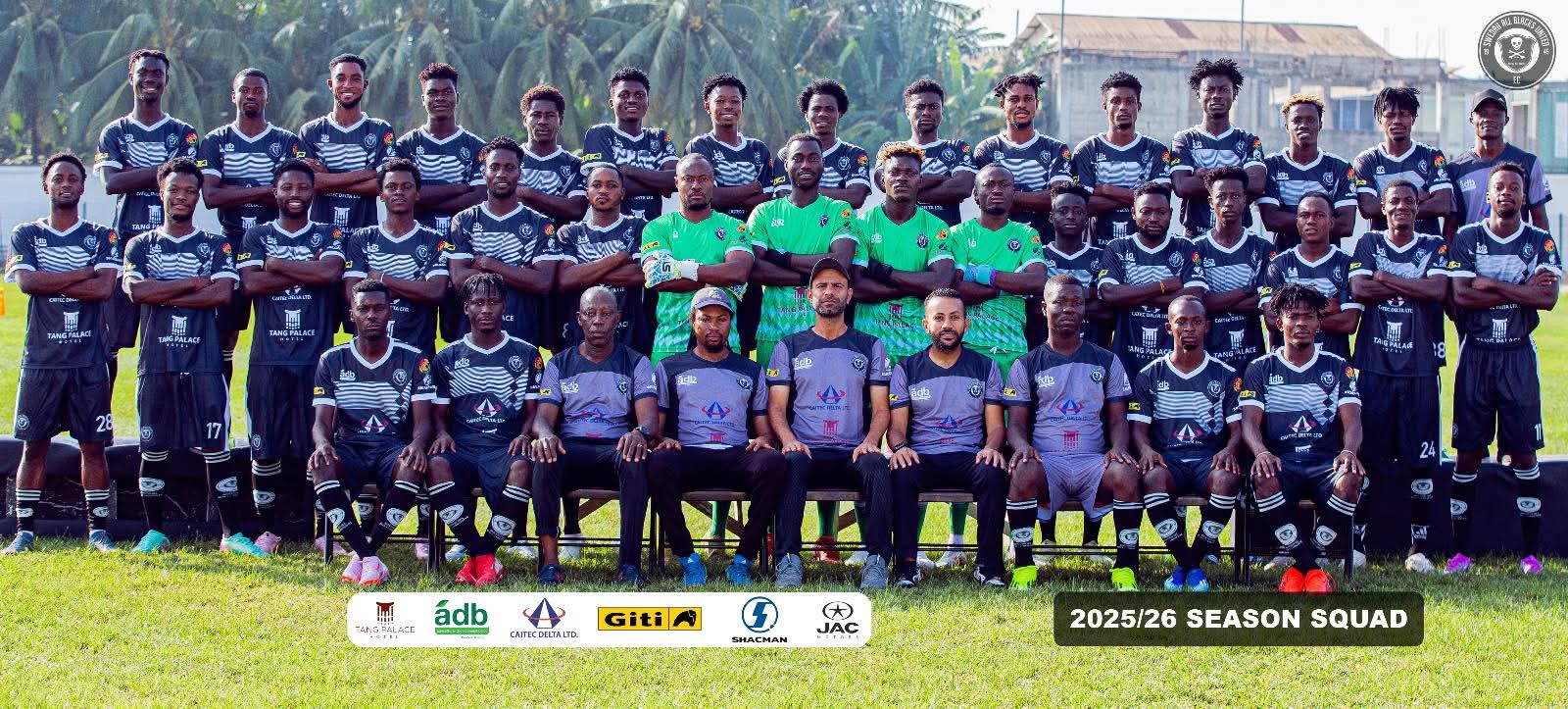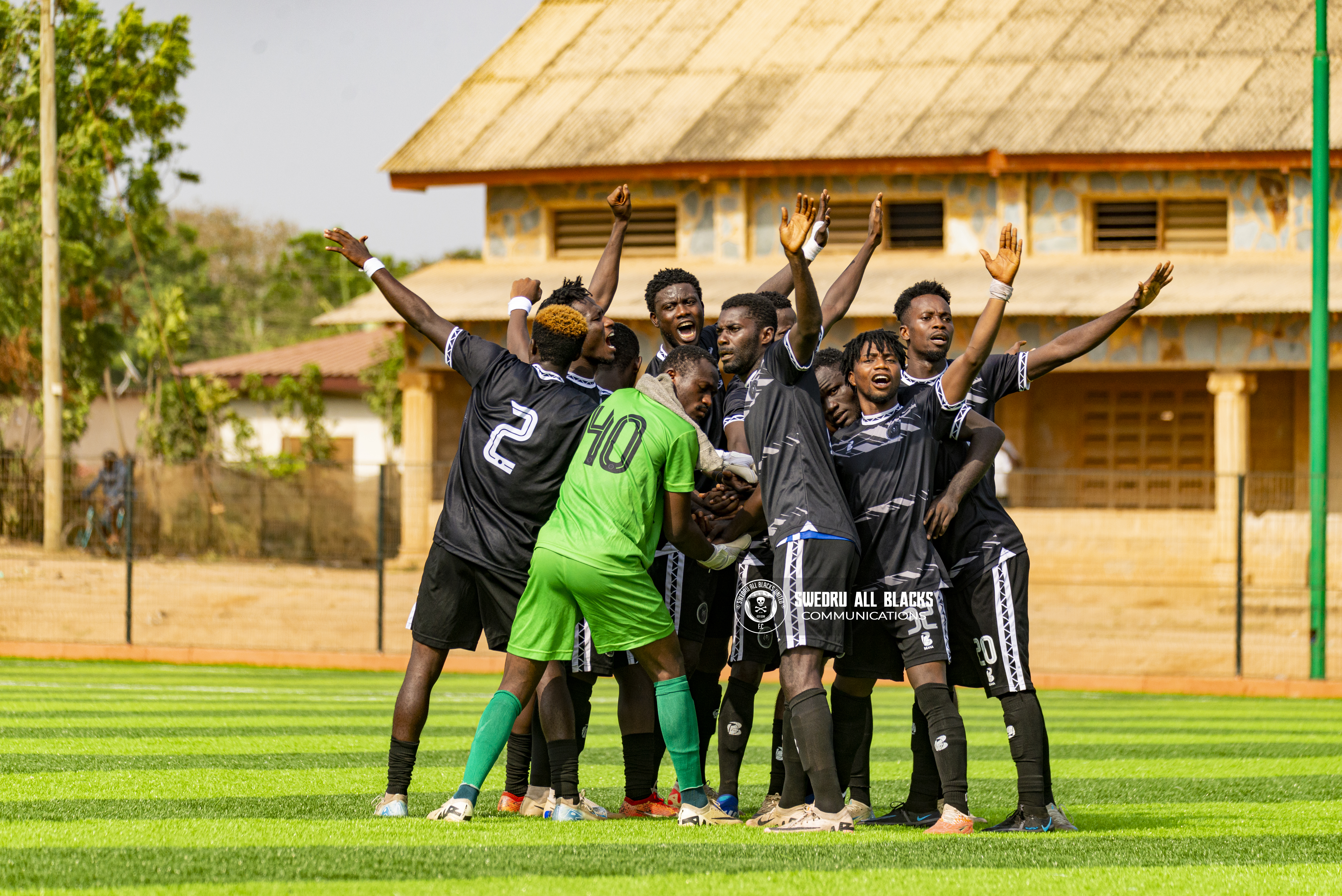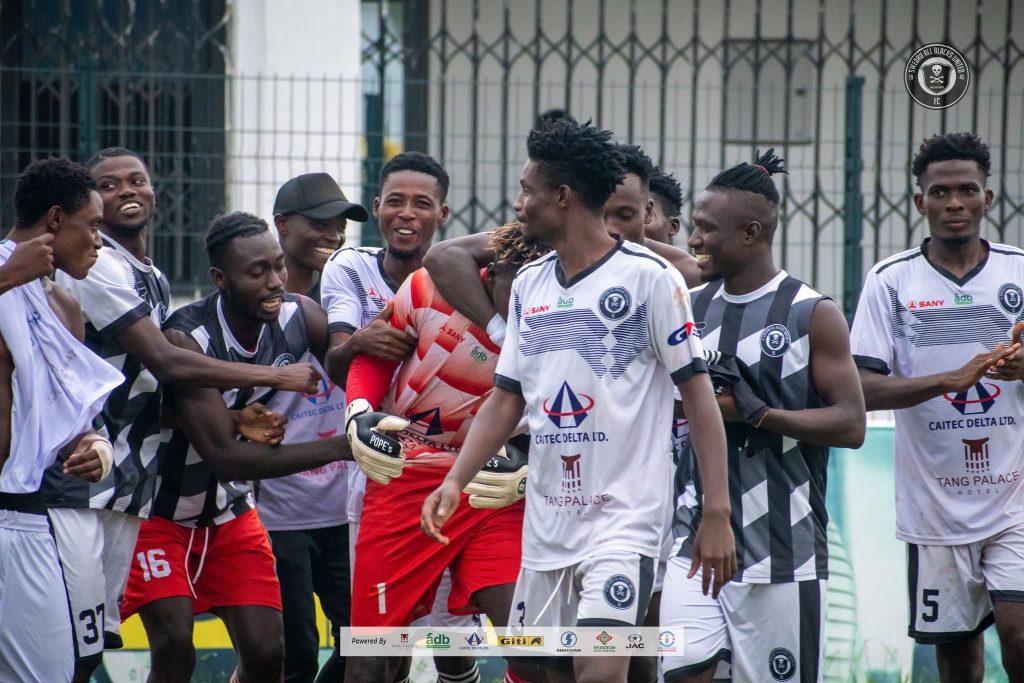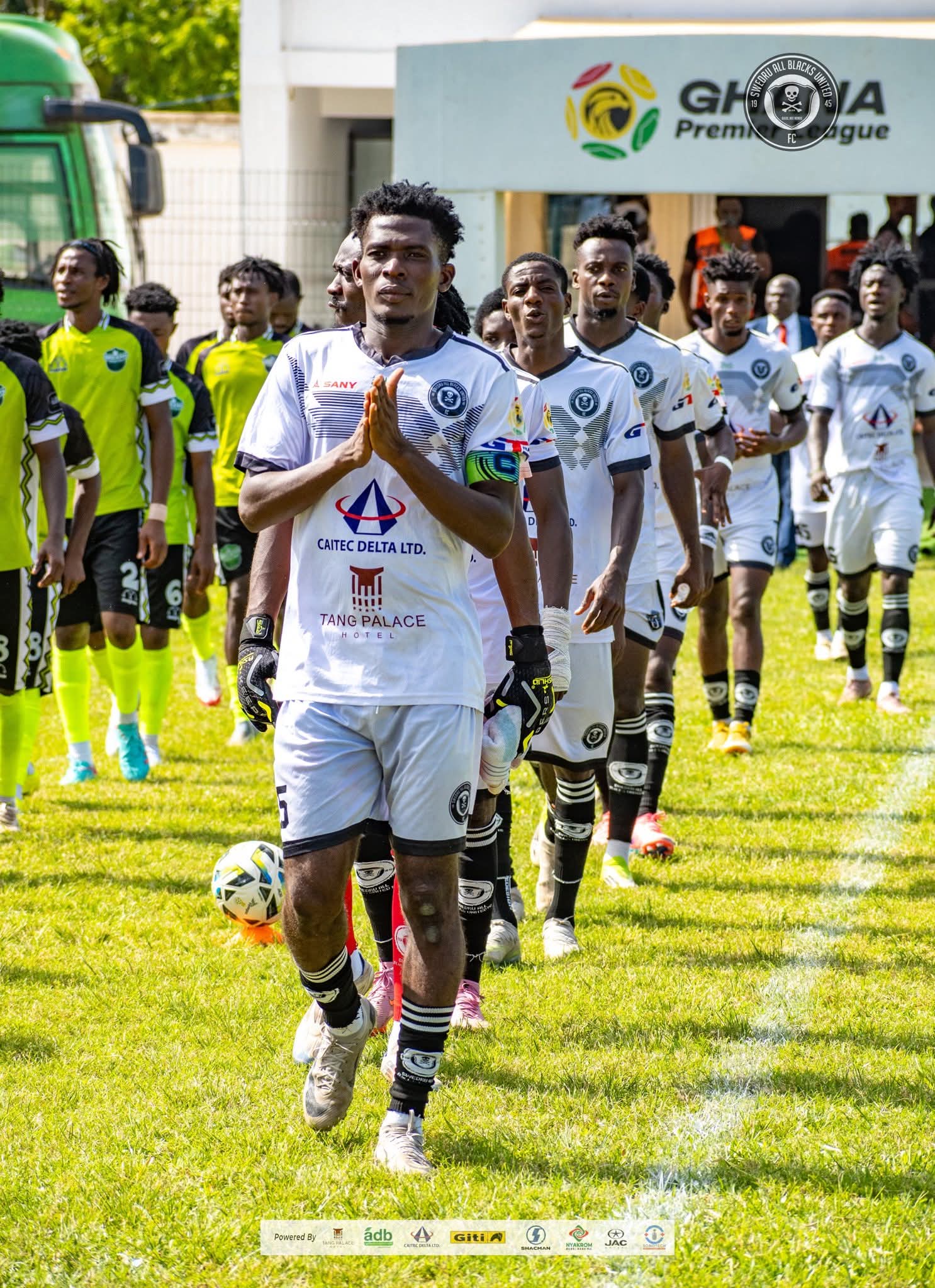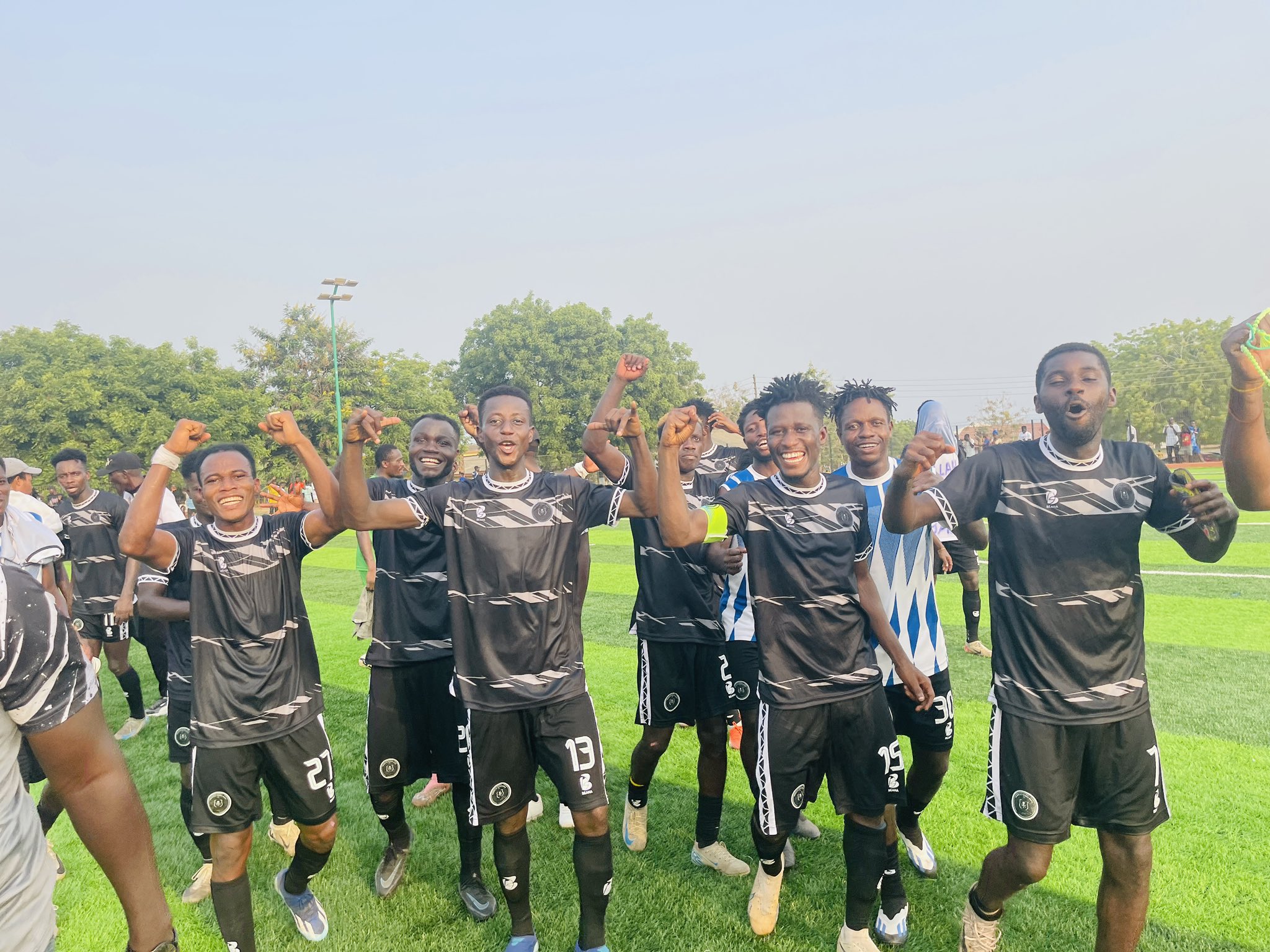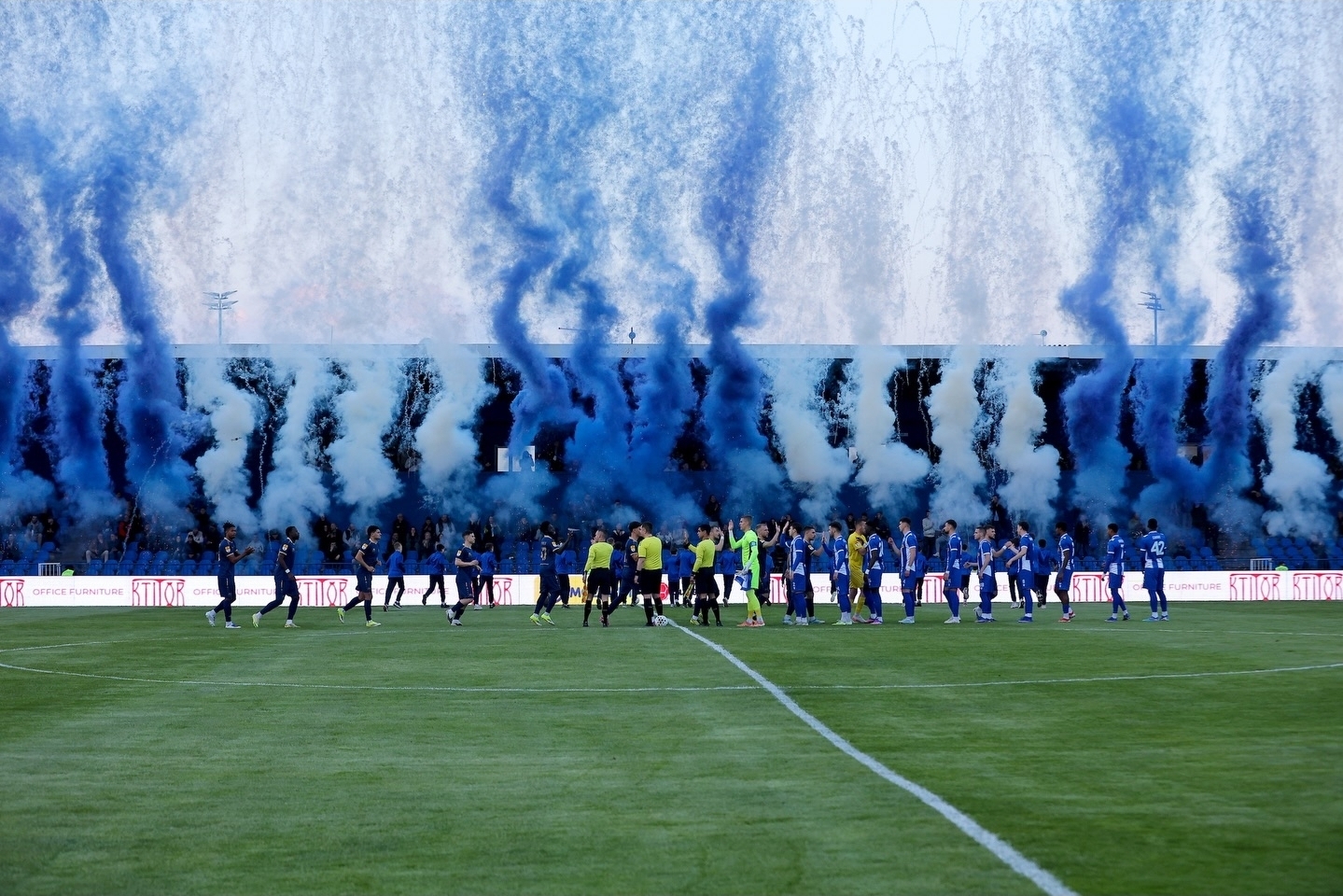
Swedru All Blacks functions as the Ghanaian origin club: identity, local access, first development and real match exposure. OFK / Belgrade functions as the European bridge: adaptation, tactical validation and proof. TTMIB turns the relationship into a controlled system: selection, timing, communication and value protection.
Contact TTMIB
Swedru All Blacks FC
Swedru All Blacks is a historic Ghanaian club from Agona Swedru, known as the Black Magicians, returned to the Ghana Premier League for 2025/26 after a long absence.
| Official Name | Swedru All Blacks United Football Club |
| Location | Agona Swedru · Central Region · Ghana |
| Common Name | Swedru All Blacks |
| Nickname | Black Magicians |
| Founded | Commonly cited reference: 1945 |
| Competition Level | Ghana Premier League 2025/26 |
| Home Base | Swedru Sports Stadium / Swedru Stadium |
| Dossier Role | Ghanaian origin club in a controlled pathway model |
Swedru should not be inflated as an African super-project. The credible angle is stronger when stated precisely: a historic Ghanaian club with real local identity, returned top-flight status, a visible stadium base and an environment that still produces unfiltered, undervalued profiles under real match pressure.
That distinction matters. Swedru is interesting precisely because it is not an academy brochure. It is a live football base. For any later pathway model, this gives the club a more honest role: origin, first assessment, competitive exposure and early-stage development.
The correct dossier angle is not hype. It is clarity: Swedru All Blacks are valuable because they are real, visible, locally rooted and again active at the highest national level. For a pathway model, that combination is useful for one simple reason — the club offers more than a logo. It offers a context in which players can be observed, assessed and shaped before moving into a European bridge environment.
Stating less, but stating it precisely, gives the dossier institutional weight. Overselling at this stage would weaken every later argument.
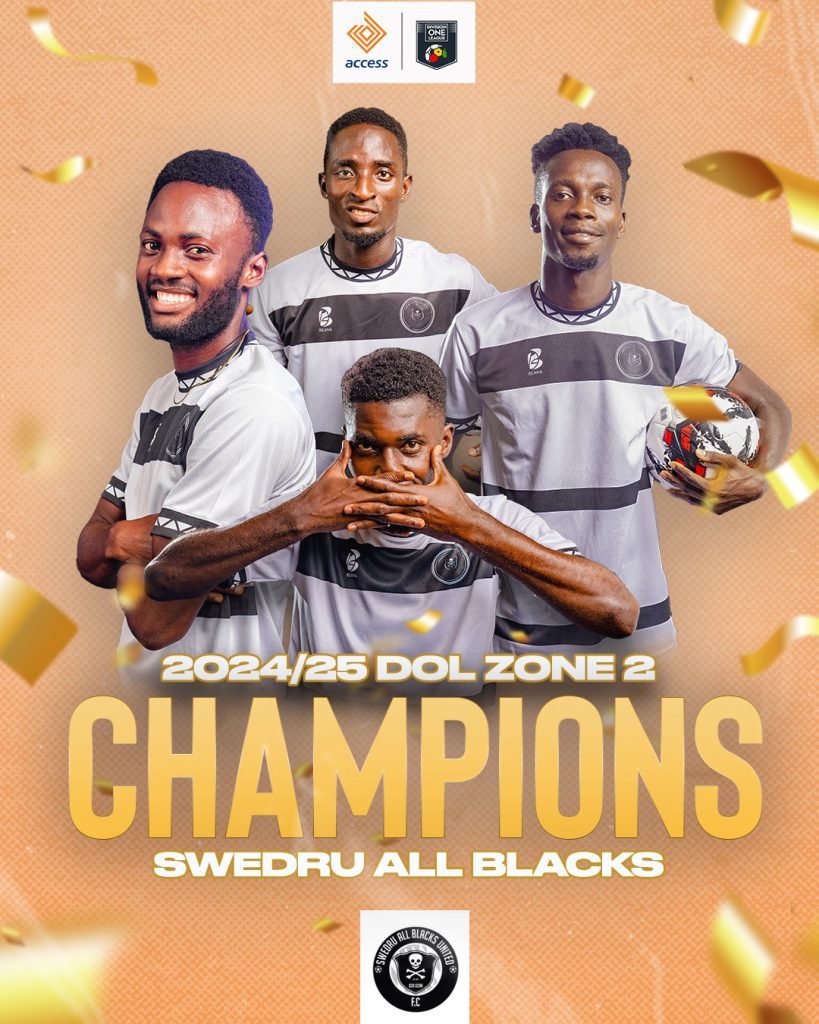
Swedru returned to the Ghana Premier League after 16 years. Promotion was sealed with a 3–0 win against New Edubiase United — 66 points after 29 matches at clinching stage.
The promotion is not a decorative note. It is the strategic turning point of the entire dossier. Without the return to the GPL, Swedru would mainly be a historic club. With the return, Swedru becomes a live top-flight platform — which is what makes the cooperation model credible.
The return reopens media attention, institutional relevance, player visibility and competitive pressure. These four things together are exactly what a pathway model needs at the source level.
| Promotion Trigger | 3:0 vs New Edubiase United |
| Promotion Metric | 66 points after 29 matches reported at clinching stage |
| League Return | Back in the Ghana Premier League for 2025/26 |
| Dossier Meaning | Heritage turned into live relevance |
The promotion story is the transition from heritage to relevance. Without the return to the Ghana Premier League, Swedru would mainly be a historic club. With the return, Swedru becomes a live top-flight platform. That is what makes the club interesting for a structured cooperation model.
This is also why the promotion image belongs inside the core narrative area of the dossier, not hidden in a gallery: it is documentary proof of institutional relevance, not emotional filler.
Visible decision-making figures stand behind the club’s recent progress — which is what makes institutional dialogue realistic.
Stephen Atto Quayson is repeatedly identified as the key leadership figure behind the club’s recent movement. His relevance is not symbolic. He is directly associated with the push to bring Swedru back into a viable top-flight stadium and operational environment.
That matters for any partnership discussion, because it signals something essential: there is a visible decision-making figure attached to real club movement, not just a dormant badge or nostalgic history.
For the 2025/26 campaign, Ahmed Ibrahim Fathi was publicly associated with Swedru as the coach entering the top-flight season. This must be handled carefully: the coach timeline is less stable than the presidency line and should always be rechecked directly before final external circulation.
The professional handling is simple: acknowledge the documented season-entry coaching structure, but avoid over-personalizing the sporting model around a coach identity unless the current status is freshly confirmed at the time of sending.
For any externally circulated version of this dossier, the coaching line should be confirmed one more time at the moment of dispatch. This protects the dossier’s credibility and prevents outdated references from being carried into formal conversation.
The Swedru Sports Stadium is one of the most important structural facts in this dossier: it proves that Swedru operates out of a real, active, league-usable football site.
Swedru Sports Stadium is the anchor of the club’s institutional reality. Reports prior to the 2025/26 season linked the venue to renovation work and club-led efforts to meet the standards required for top-flight competition. That does not turn the stadium into a luxury asset — but it proves seriousness, viability and football function.
For a later pathway discussion, that matters because player development and recruitment credibility always improve when a club has a real home base, a local matchday environment and a visible football identity tied to place.
| Venue | Swedru Stadium / Swedru Sports Stadium |
| Capacity Reference | Approx. 5,000 |
| Operational Relevance | Used for Ghana Premier League fixtures |
| Pre-season Context | Renovation / readiness work reported before 2025/26 |
| Institutional Read | Active, visible, league-usable football site |
| Strategic Meaning | Real club base, not theory |
This is a pressure environment, not a comfort environment. That is what makes behavioural reading of players honest.
The useful football logic around Swedru lies in context. This is not a sterile showcase environment. It is a club with real promotion momentum, current survival pressure, a visible home base and a need to compete every week for relevance and points. That makes behavioural reading more honest.
Selected player references already appear in public reporting, which means there is a visible starting layer for future live profile analysis. For a scouting or partnership dossier, that is enough at this stage. The next level is direct, role-specific player breakdowns, not generic squad listing.
The club therefore offers something useful for a later pipeline model: players can be read at source, under actual football stress, before being flattened into highlight-reel scouting.
Swedru is the right origin club because it combines real access, top-flight pressure and development room — before market inflation starts.
Direct contact to Ghanaian profiles at source level, not through second-hand market noise.
GPL status changes the seriousness of observation and institutional visibility.
Players are judged in real competitive conditions, not in protected academy settings.
Profiles can be identified before valuation inflation and before poor external positioning.
Swedru is serious enough to matter but raw enough to leave development value for Europe.
The club becomes a repeatable entry point, not a one-off talent collection.
The correct argument is not: “Swedru is already an export factory.” The correct argument is: “Swedru is a credible Ghanaian origin club with enough visibility, pressure and authenticity to become the first layer of a serious pathway.”
That framing is stronger because it is professional, defensible and does not over-promise. Over-promising at the origin level damages everything downstream — the bridge club, the next market and the player’s real development.
An older crest is not decoration. It is proof that the club has existed long enough to build a football culture, a local fan memory and a regional identity. In a pathway model, that heritage matters: it signals stability, not a hype project built for one transfer window.
For Belgrade and for any future European partner, the older identity is part of the reassurance: Swedru is a real, continuous Ghanaian club — a source, not a brochure.
African talent is often moved too late, too randomly or into the wrong environment. The missing piece is not talent. The missing piece is structure.
Many African players do not fail because they lack ability. They fail because the transition is organised badly: wrong timing, wrong club, wrong expectation, weak family communication, no adaptation phase, trial-chasing instead of structure.
Swedru alone does not solve this. OFK alone does not solve it. TTMIB alone does not solve it. Value only emerges when all three layers are connected cleanly.
This proposal should therefore not be sold as a player-export idea. It should be sold as a controlled transition model. Ghanaian talent needs a reliable origin club, a professional operator and a European bridge environment where adaptation can happen before a larger market step.
Without that three-layer discipline, the project collapses back into random recruitment: the same failure pattern that has cost African football credibility and value for years.
Players shown too late. Wrong clubs. Wrong timing. Family told a different story than the club. Trials chase trials. Value burns before it is ever built.
One source club. One operator. One bridge environment. Profiles filtered, moved at the right time, communicated cleanly to all sides. Value built, not burned.
Development at source. Governance in the middle. Validation in Europe. Movement upward only after proof.
Identification, local access, match exposure and first-stage development in Ghana. Character and behaviour reading under real pressure.
Profile filtering, dossiering, timing, family communication, club-to-club alignment and value protection across the chain.
European adaptation, tactical rhythm, physical proof and market readability under real European conditions.
Only after evidence: stronger Serbian level, Balkan, Belgium, France, Turkey, wider Europe, or MLS when profile and timing align.
The correct model is not random transfer traffic. It is a controlled football chain. Swedru functions as the Ghanaian origin node: identification, first assessment, real match exposure and first-stage development in a visible club under competitive pressure.
TTMIB does not act merely as an introducer. The role is integrative: profile selection, club matching, pathway planning, dossiering, communication flow, family handling, timing and value protection. That governance layer prevents the pathway from collapsing into informal trial-chasing.
The European bridge step then has one task: proof. Not academy rhetoric. Not vague promise. Proof under European demands. Once proof is delivered, the next market move becomes credible and financially cleaner.
| Phase 1 | Identify and shape talent at source in Swedru |
| Phase 2 | Profile, document and filter the right cases through TTMIB |
| Phase 3 | Move selected profiles into a Belgrade / Serbia adaptation environment |
| Phase 4 | Validate under European intensity, discipline and competitive rhythm |
| Phase 5 | Open the next market only after real proof has been delivered |
The model is built on one principle: no player should be moved only because he is talented. He should be moved because the next environment fits his development phase. Talent without fit is a gamble. Fit without talent is a waste. Only the combination produces repeatable results.
Serbia is not a downgrade. It is a strategic European adaptation corridor.
For many African players the direct jump into the biggest markets is too early. They first need an environment in which they can learn: European training rhythms, tactical discipline, contact intensity, climate, culture, language, decision pressure, professional expectations.
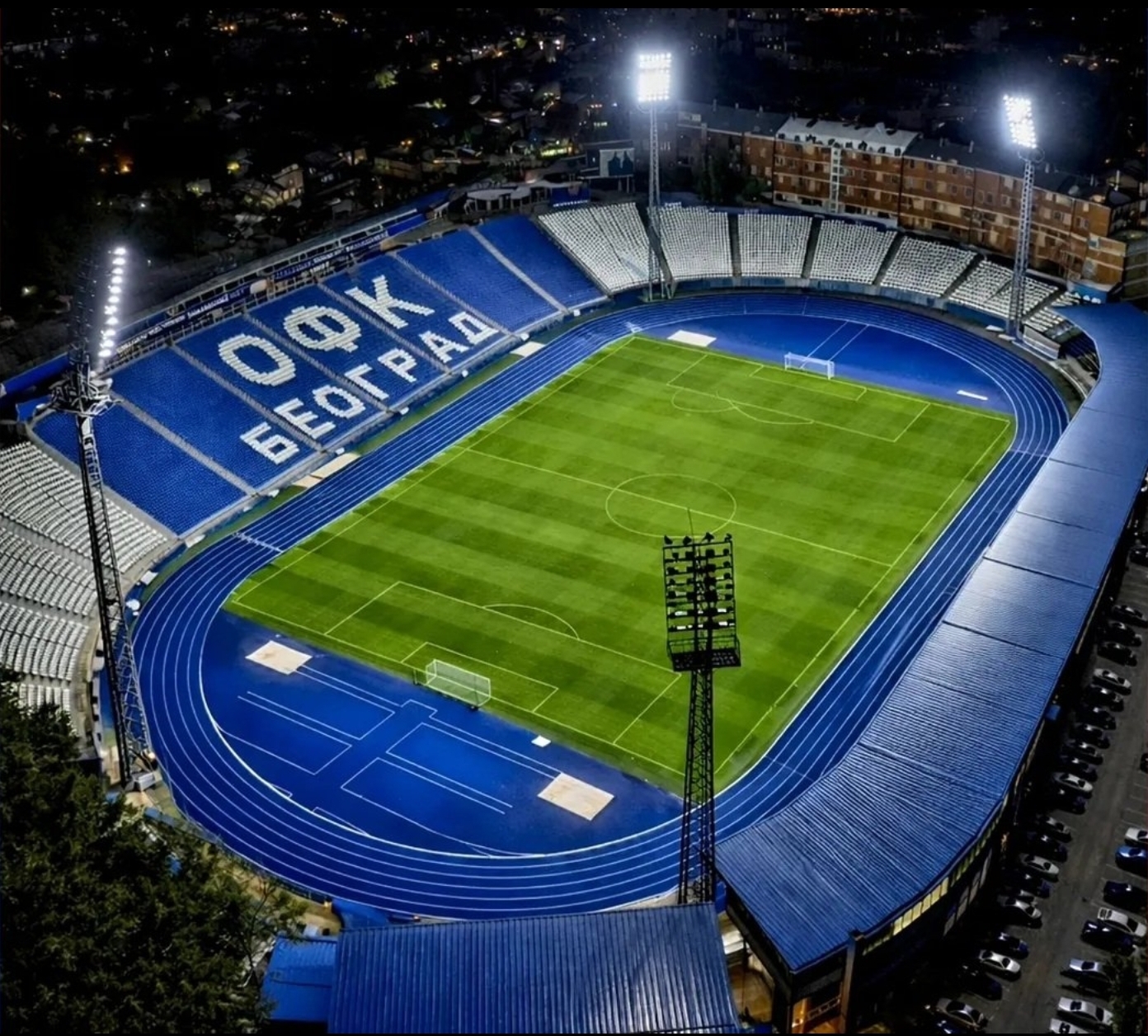
Belgrade as a location combines European football hardness, visibility and a real development corridor. OFK should not be framed as an accessory to another club — OFK must be described as a standalone Belgrade football base and a credible bridge partner.
OFK Beograd
Earlier access to filtered Ghanaian profiles with development margin. Better signal-to-noise than open market scouting.
Credible European continuation path for selected players — international credibility beyond local prestige.
A fairer first European proving ground before larger markets demand a finished product on day one.
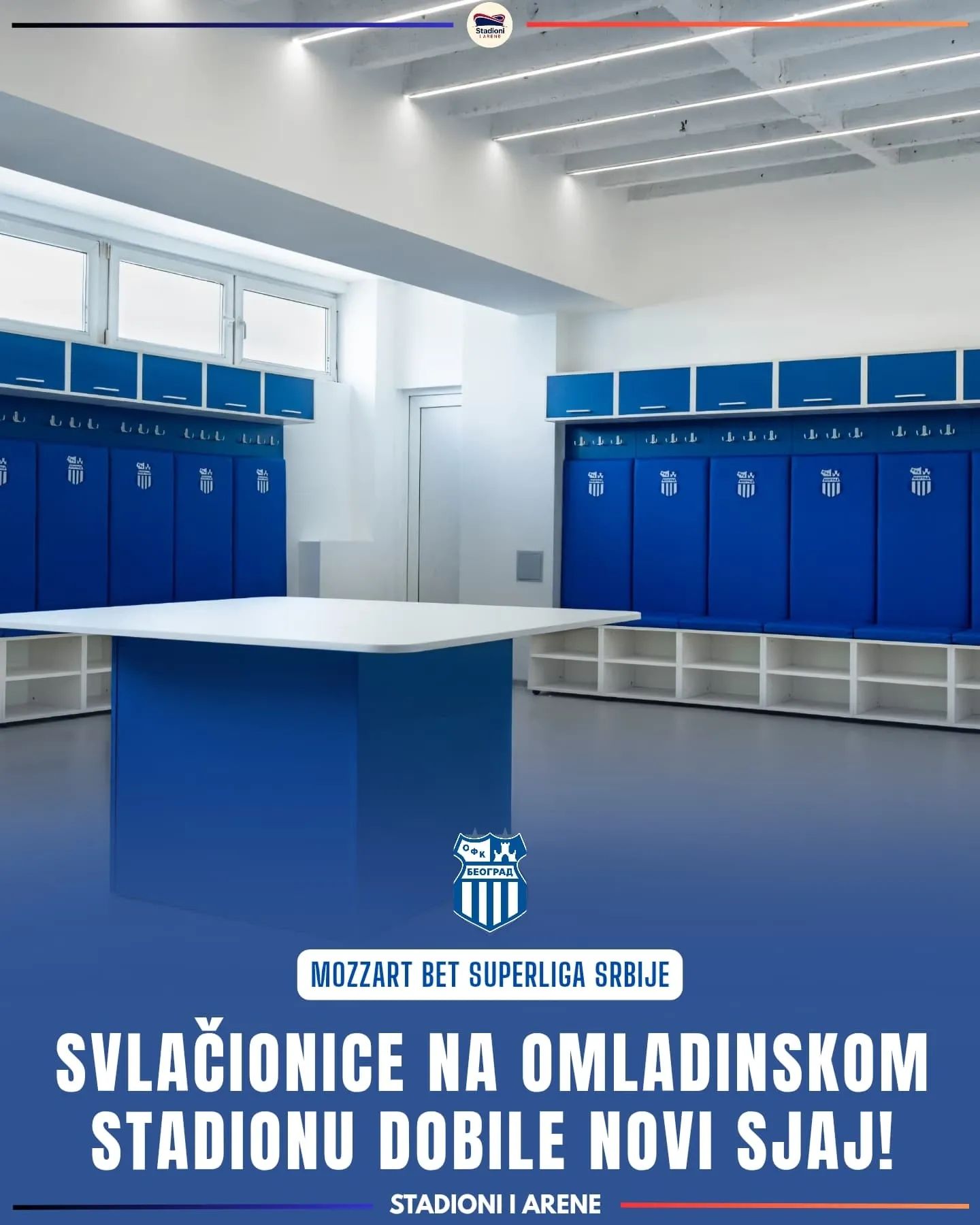
A European bridge is not a press conference. It is a dressing room, a pre-match routine, a weekly physical load and a daily professional rhythm. That is the environment in which a Ghanaian player is either ready to adapt — or not.
The OFK dressing-room reality is part of the proof logic: arriving players step into a structured European workspace on day one. Everything about the pathway — selection, timing, expectation management — is designed to prepare them precisely for this environment.
The correct wording is not: “OFK takes African players.” The correct wording is: “OFK can become the European validation node inside a controlled Ghana–Serbia pathway, receiving better-filtered profiles from a real Ghanaian origin club.”
Why it makes sense for OFK: earlier access, better filtering, reduced scouting dispersion, clearer profile packages, pre-prepared origin logic, possible transfer-value uplift after European validation.
Why it makes sense for Swedru: credible European continuation, more attractiveness for local talent, more professional development perspective, higher value creation on fitting profiles, international credibility.
TTMIB is the layer that turns isolated talent access into a controlled international football pathway.
Without a controlling layer, the cooperation is exposed to the usual failure pattern: random contacts, wrong profiles, poor communication, bad timing, family pressure, unclear responsibilities, unprotected values, trial chaos.
With TTMIB in the middle, the project becomes a controlled process. TTMIB combines advisory, agency, network, club communication, dossiering, scouting translation, timing and expectation management into one operational layer that actually drives the process.
| Identify | Recognise players and role profiles at source |
| Filter | Only fitting profiles move forward |
| Package | Professional dossier, video and data logic |
| Coordinate | Clubs, players, families, coaches and scouts aligned |
| Protect | Timing, value, credibility and reputation safeguarded |
Do not present TTMIB as only “agent contact”. That underrepresents the role. The correct description is pathway operator: intermediary, agency, network and execution layer at the same time. Without that operator function, everything else in this dossier is just an idea on paper.
This pathway is not for every player. It is for players who can adapt, suffer, learn and prove.
Families must be told the truth clearly: the European bridge is not luxury at step one. It is adaptation, discipline, patience and building credible football evidence. If that truth is hidden, trust later collapses.
Partner clubs also need honesty. Swedru should not oversell raw profiles. Belgrade should not be overloaded with ill-fitting cases. The route only works when movement stays selective and fit-driven.
| Player duty | Discipline, adaptability, physical care, respect for the process |
| Family duty | Understand the pathway as a long build, not an instant upgrade |
| Club duty | Communicate clearly, assess honestly, move only when fit is proven |
| TTMIB duty | Hold all three sides on one disciplined line |
The player must understand Serbia as a project, not as a downgrade. The first European step is not about glamour. It is about proof. If he proves himself there, the next market becomes credible.
In real pathways, bad communication destroys as much value as bad scouting. That is why TTMIB has to manage not only football logic, but expectation logic.
Not protected academy minutes. Real GPL exposure, real weekly stakes.
European intensity, tactical demand, daily professional rhythm.
Consistent weekly output, duel counts, decision speed, load capacity.
Only after proof — then the door opens cleanly, not on hope.
The cooperation should start with a controlled pilot, not with big promises.
The cooperation should not be sold as a plug-and-play solution. It should be presented as a disciplined build. A serious pathway does not announce itself in a press release. It earns its right to exist through the first year of quiet, selective, well-documented work.
Only after that proof should the model be scaled — and only then should it be branded as an established Ghana–Serbia corridor.
Every image in this dossier carries a specific argument. Click any picture to open the lightbox and browse the full visual story of the Ghana–Serbia pathway.
Promotion · 2025
Squad 25/26
On the field
Team mood
Walk-in
On the pitch
Heritage crest
Current crest
Stadium
OFK crest
Dressing room
Dressing room · II
Tribune · fansEvery image must carry a specific argument. When the same picture appears three times across a dossier, the argument weakens — not strengthens. One hero image, one promotion image, one stadium image, one training image, one Belgrade image, one pathway visual. Everything beyond that must earn its place.
The gallery here is the exception to that rule: a consolidated visual index that lets the reader re-enter the story through the pictures instead of the text.
This proposal is not about sending players randomly from Ghana to Europe. It is about building a disciplined pathway. Swedru All Blacks offer the origin: identity, access, first exposure and competitive pressure. OFK / Belgrade offers the European validation stage: adaptation, discipline and proof. TTMIB connects both sides and protects the process through structure, timing, communication and market logic.
The value is not one player movement. The value is a repeatable system.